
Yiwu Market's New 6th District Is the Biggest Sourcing Opportunity SMEs Have Seen in a Decade
A 1.25-million-square-meter digital trade powerhouse just opened in Yiwu, China — and your competitors probably don't know about it yet. Here's why it matters, what you can source there, and how the current energy crisis makes it even more lucrative.
SUPPLY CHAIN INSIGHTS
4/8/20265 min read
Total complex area — bigger than 175 football pitches
1.25M m²
5,000+
Booths across 8 emerging industries
57%
Vendors with proprietary brands or IP-driven products
30 days
Visa-free entry into China — now for EU, UK & Canada
170+
Countries connected through District 6's digital trade network
What Is Yiwu District 6, Exactly?
If you've sourced products from China before, you already know Yiwu. For decades, the city in Zhejiang Province has been home to the world's largest small-commodity wholesale market — over 75,000 booths spread across five giant districts, selling everything from Christmas decorations to smartphone accessories. In 2022 alone, the market generated around USD $70 billion in sales.
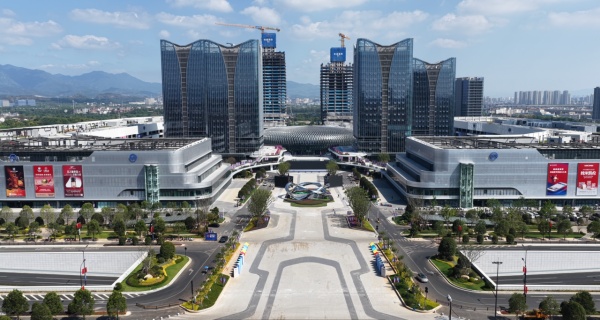
But on October 14, 2025, something fundamentally new arrived. The Yiwu Global Digital Trade Center — officially known as District 6 or the "6th-generation market" — opened its doors. And it's not just a bigger version of what came before. It's a different category of trade infrastructure entirely.
Districts 1–5 are physical wholesale markets organized by product category. District 6 is a function-based digital trade ecosystem — combining showrooms, live-streaming studios, AI navigation, bonded warehouses, customs clearance, and cross-border payment services all under one roof. Think of it as the difference between a traditional bazaar and a tech-enabled trading platform that also happens to have physical space.
Key Distinction
The complex is structured across five zones: a marketplace spanning 410,000 m², office towers, a commercial and lifestyle street, residential apartments, and a 7,000 m² "Digital Trade Hub" — described as the brain of the whole operation, connecting trade data, logistics analytics, and market intelligence in real time.
What's on Each Floor — The Buyer's Quick Map
The main market section organizes its 5,000+ booths across 5 major sectors, 12 industries, and 34 product sub-categories. Here's the practical floor-by-floor breakdown for buyers:
F1 & F2
Fashion Jewelry, Creative Collectibles & Smart Wearables
AI-designed jewelry, opal silver accessories, IP-branded collectibles, Labubu-style doll clothing, blind boxes, trend toys
Smart Devices, Drones, Robots & AR/VR Equipment
F3
Consumer drones, desktop robots, AI gadgets, VR headsets, smart home controllers, wearable tech
Fashion Fabrics, Baby Products & Medical Aesthetics
F4
Premium textiles, maternity-to-infant integrated zones ("Maternity Zone" strollers + toys), skincare devices, beauty tech
F5
Cross-Border E-commerce Services & Digital Trade Hub
Amazon, TikTok Shop and Shopify-partnered service zones, customs consulting, freight forwarding, brand IP registration, finance services
What to Source: Products Built for Today's Online Market
Here's where it gets really interesting for e-commerce sellers. Unlike the older districts which lean heavily on legacy categories, District 6 has been deliberately curated for what's trending on Amazon, TikTok Shop, and Shopify right now. Over 57% of vendors are either proprietary brand owners or IP-driven sellers — meaning you'll find products with real design differentiation, not just generic commodity items.
The Energy Crisis Connection — Why This Is Your Moment
One of the most eye-catching developments in the market is the surge of energy-related and power-management products. Portable solar panels, compact battery banks, smart energy monitors, and low-draw LED systems are commanding serious shelf space — and for very good reason.
Electricity prices across Europe remain structurally well above pre-2021 levels. The European Commission acknowledged in its February 2025 Affordable Energy Action Plan that high energy costs continue to hurt both EU citizens and business competitiveness. The European Central Bank has estimated that a sustained 10% rise in electricity prices can reduce employment in energy-intensive sectors by up to 2% — and EU electricity prices are currently running at roughly 2.5 times the US equivalent.
For SMEs in Germany, the UK, France, and Canada, energy bills have become a direct threat to margins. But here's the flip side: this crisis has created an enormous consumer appetite for affordable energy-saving technology. Heat pumps, smart thermostats, portable power stations, solar-assisted lighting, energy monitoring plugs, and low-draw heating devices are all seeing surging demand across European retail channels — and most of those consumers are searching on Amazon and Google right now.
European consumers are spending more on energy than ever — and actively looking for solutions to cut those bills. China's manufacturing ecosystem, particularly through platforms like District 6, is producing these products at wholesale prices that give you 40–70% gross margin potential when sold on Amazon Europe, Amazon UK, or Shopify. The product-market fit is already validated. The demand already exists. You just need the supply chain.
Categories that connect directly to the energy crisis narrative — and carry strong SEO demand with lower Amazon competition than legacy categories like phone cases or yoga mats — include portable solar generators, smart power strips with energy monitoring, LED grow lights, wireless thermal sensors, and compact heat recovery ventilation units. Many of these can now be sourced directly from District 6 vendors who are specifically geared toward cross-border e-commerce.
The Opportunity in Plain Terms
Why FBA Europe and Shopify Sellers Specifically Win Here
The energy crisis has accelerated a behavioral shift: European consumers are buying more online, not less, because physical retail is being squeezed. At the same time, Amazon FBA sellers with UK and EU accounts benefit from localized inventory that circumvents long shipping lead times. Sourcing energy-efficiency products through District 6, air-freighting hero SKUs, and then running sea freight for replenishment is a textbook FBA playbook — and District 6's integrated bonded warehouses and customs clearance services are purpose-built to support exactly this workflow.
For Shopify sellers, the District 6 live-streaming infrastructure opens an even more interesting door. Vendors broadcast in real time on TikTok, YouTube, and Alibaba Live — which means you can attend a product showcase without flying to China, compare suppliers in a single afternoon session, and place orders the same day.
The Visa Game-Changer: You Can Walk In Yourself — No Visa Required
Here's a development that removes the single biggest barrier most Western SME owners cite when it comes to sourcing trips to China: the visa. Since February 17, 2026, UK and Canadian citizens can enter China visa-free for up to 30 days. Most EU member states have been on China's visa-free list since 2024, with the policy now extended through December 31, 2026.
In practical terms, this means that an SME owner based in London, Paris, Frankfurt, or Toronto can now book a return flight, land in Shanghai or Hangzhou (both within easy reach of Yiwu by high-speed rail in under 2 hours), spend a week touring District 6, negotiate directly with suppliers, place sample orders, and fly home — all without a single visa application. That friction removal is genuinely significant.
Yiwu itself is 15 minutes from its own railway station, which connects to high-speed rail from major Chinese cities. From Hangzhou — itself a 40-minute flight from many Asian hubs — it's a 35-minute train ride. The logistical math works.
The Bottom Line
Yiwu Market District 6 is not just a new building. It represents a structural upgrade in how China connects its manufacturing base to the world's e-commerce sellers — and it has arrived at precisely the moment when European consumers need affordable, energy-efficient alternatives the most. The visa barrier is gone. The digital infrastructure is in place. The product categories are aligned with what's selling.
For SMEs, Amazon FBA sellers, and Shopify entrepreneurs in Europe, the UK, and Canada, this is one of those rare moments where the sourcing landscape, the geopolitical context, and the consumer demand are all pointing in the same direction at the same time. The question is not whether to pay attention to District 6 — it's how quickly you can move before everyone else does.
If you need a partner who already knows the floor plan, speaks the language, and has supplier relationships in place — you know where to find us.
Sources: Yiwu Global Digital Trade Center official opening, October 14, 2025 · People's Daily Online · PRNewswire/Yiwugo.com · CGTN · European Commission Energy Action Plan Feb 2025 · ECB Blog on energy prices and employment, May 2025 · China-Briefing.com visa-free policy tracker · VisasNews.com · Jing Sourcing District 6 field report, February 2026
Article updated April 2026. Visa policies subject to change — verify current status at the Chinese National Immigration Administration website before travel.